Extrusion Production
Press lines from 800T to 2500T cover thin-wall precision sections through large structural profiles, with isothermal process control holding wall thickness within ±0.1 mm.
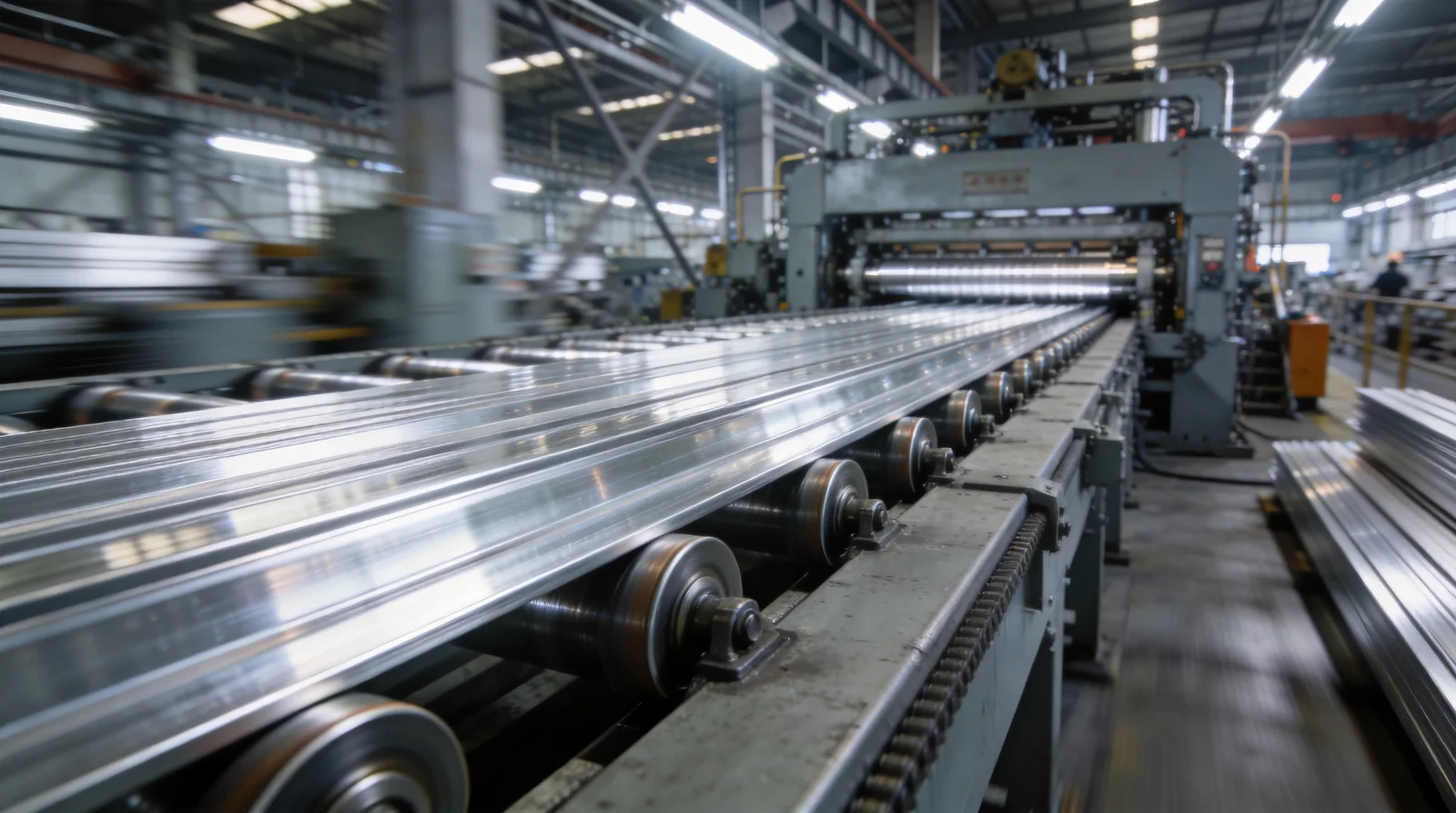
In one line: Press lines from 800T to 2500T cover thin-wall precision sections through large structural profiles, with isothermal process control holding wall thickness within ±0.1 mm.
Aluminum Alloy Extrusion Lines
Equipped with 6-12 units of
800T/1200T/1800T/2500T CNC extrusion presses
different tonnages correspond to different profile scenarios:
800T/1200T: Suitable for small decorative profiles and thin-wall precision profiles (e.g., door/window frames, electronic heat sinks);
1800T/2500T: Suitable for large industrial profiles and thick-wall load-bearing profiles (e.g., solar brackets, mechanical structural parts).
Isothermal extrusion process: Maintain stable temperature during extrusion via precise temperature control,
ensuring uniform profile wall thickness with a tolerance of ≤±0.1mm
—avoiding issues like installation misalignment or insufficient structural stability caused by wall thickness deviations;
Online quenching system: Complete T5/T6 heat treatment synchronously,
increasing profile strength by over 30%
—suitable for heavy-load, high-stress industrial scenarios.
Equipped with a PLC control system, automatic billet feeder, and puller machine, enabling full-process automation from "billet feeding → extrusion → forming → pulling":
Reduce dimensional deviations and rhythm disorders caused by manual operations;
than traditional semi-automated lines, with daily output increasing by ~2 tons—effectively shortening order delivery cycles.
Extrusion Process Quality Control
Via intelligent sensing and data acquisition systems,
real-time monitor extrusion temperature (precisely maintained at 480-520℃) and extrusion speed
—avoiding profile defects such as bubbles, surface scratches, and deformation caused by parameter fluctuations.
Combined with online visual inspection technology, real-time screen surface and dimensional quality of formed profiles, controlling the
surface defect rate at ≤0.5%
—greatly reducing time and cost losses from defective product rework and scrapping.
After extrusion, additional sampling dimensional inspections (matching customer-specified tolerance standards) and performance spot checks (e.g., hardness, tensile strength) are conducted—ensuring the delivered profiles fully meet precision and performance requirements.
Raw Material Assurance & Preprocessing
Aluminum Billet Warehousing System
30,000 Tons Annual Warehousing Capacity · Full-Spec Compatibility + Constant Temperature Protection
Warehousing & Production Capacity
Boasting an annual production capacity of 30,000 tons of standardized aluminum billets, our warehouse simultaneously stocks multi-specification billets with diameters of 90-150mm and lengths of 3-6m. Supporting a full range of alloy grades including 6063/6061/6005A/7075, we fully meet the OEM requirements of construction, industrial manufacturing, high-end manufacturing, and other scenarios.
Constant Temperature Protection
Adopting a closed constant temperature warehouse design with temperature controlled at 15-25℃ and humidity ≤60%, it avoids aluminum billet oxidation and moisture absorption from the source, ensuring the stability of the extrusion process.
Full Inspection Process Zone for Incoming Raw Materials
Zero-Error Raw Material Testing | 100% Unqualified Product Rejection
Inspection Process & Traceable Reports
With a sampling ratio of ≥5% for aluminum billets per batch, inspection items include alloy purity, surface defects, and tensile strength. Unqualified raw materials are directly rejected, ensuring a 100% acceptance rate for incoming materials. An electronic inspection report is generated for each batch, enabling OEM customers to access raw material data synchronously.
Equipped with high-precision optical emission spectrometers (alloy composition error ≤0.01%), Brinell hardness testers, and mechanical property testing machines, it covers comprehensive "composition - hardness - strength" testing across all dimensions.
Aluminum Billet Homogenization + Surface Preprocessing
Homogenization Process · Raising Profile Yield Rate to 98%
Equipped with a 12-meter continuous homogenizing furnace (temperature control precision ±2℃), the process involves holding aluminum billets at 480-520℃ for 6-8 hours. This eliminates internal stress, refines grain structure, and increases the uniformity of the profile’s microstructure by 90%.
After homogenization, the profile yield rate increases from the industry average of 92% to 98%, and the adhesion of subsequent surface treatments is enhanced by 30%.
Adopting automatic shot blasting + chemical derusting technology, it removes oxide layers and oil stains from the aluminum billet surface, reducing extrusion defects such as scratches and bubbles.
Send Your Drawing — Get a Quote in 24 Hours
Rough sketch, PDF, DWG, DXF or STEP. Free engineering review, free sample, free die revision.