Surface Finishes
Anodizing, powder coating, electrophoresis, wood-grain transfer, brushing and polishing — finished in-house so color consistency and corrosion performance are controlled, not outsourced.
In one line: Anodizing, powder coating, electrophoresis, wood-grain transfer, brushing and polishing — finished in-house so color consistency and corrosion performance are controlled, not outsourced.
Full-Surface Treatment Process
Basic Surface Treatment Processes
Full Range of Surface Finishes · Tailored for Diverse Application Scenarios
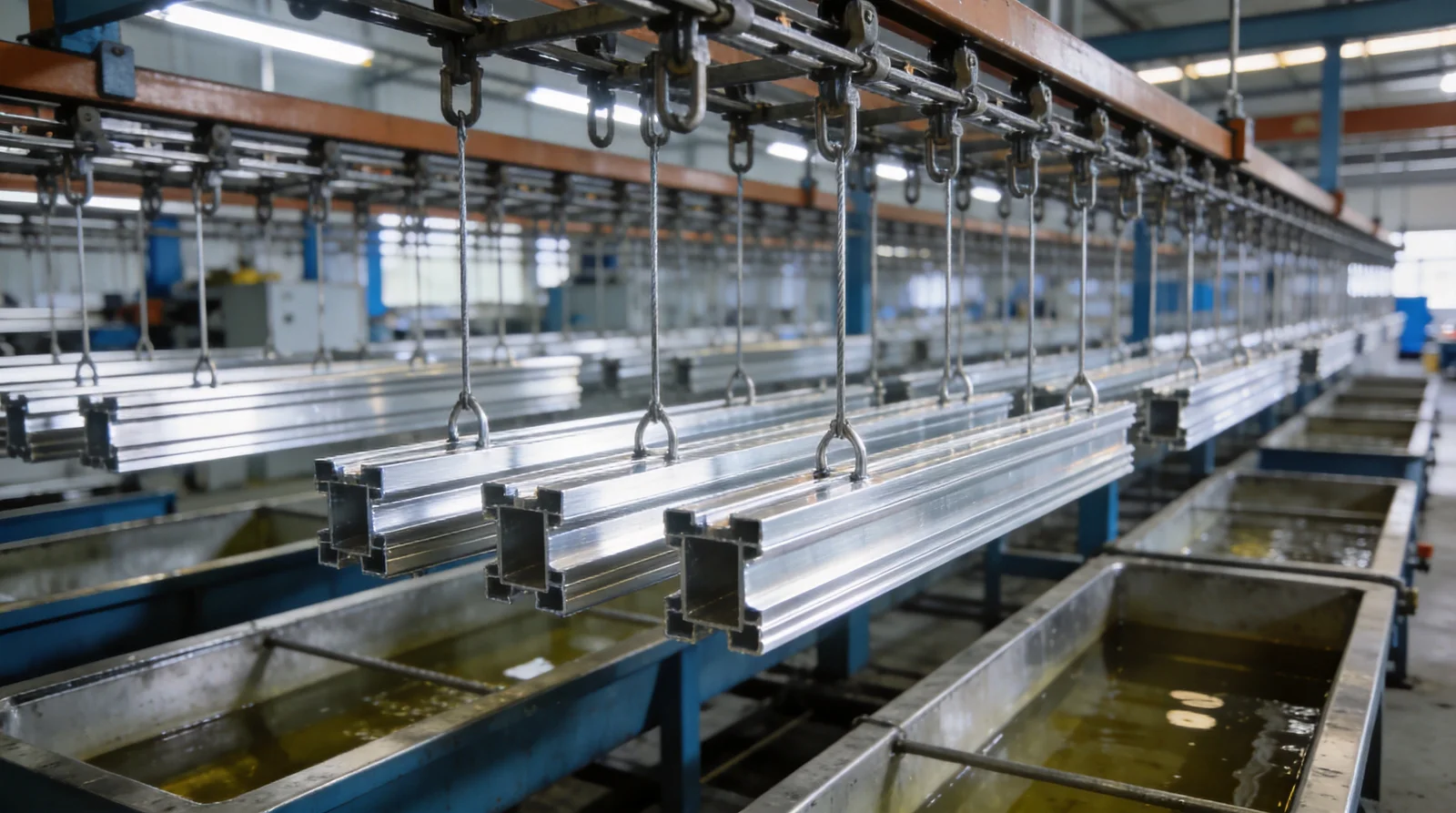
Aluminum Alloy Anodizing Workshop
Core Parameters: Standard Anodization: Film thickness 5-15μm, suitable for architectural decoration OEM products;
Hard Anodization: Film thickness 20-50μm, hardness ≥300HV, suitable for industrial wear-resistant components (e.g., mechanical guide rails, auto parts).
Process Advantages: Enhances the corrosion resistance and wear resistance of profiles, enabling natural color/coloring effects..
Aluminum Alloy Electrophoresis Workshop
Process Name: Cathodic Electrophoresis
Paint film thickness: 15-25μm
Salt spray test resistance: ≥1000 hours (far exceeding the industry average of 600 hours);
Optional gloss levels: Matte / Satin / High Gloss.
Boasts uniform and smooth paint film with strong adhesion, ideal for humid/high-corrosion environments (e.g., coastal buildings, bathroom profiles).
Aluminum Alloy Spraying Workshop
Process Name: Powder Coating / Fluorocarbon Coating / Wood Grain Transfer
Electrostatic powder spraying + automatic powder coating line, film thickness 60-120μm, full coverage of RAL color card (200+ color options).
Fluorocarbon Coating (PVDF)
Two-coat / three-coat process, weather resistance ≥20 years, fading rate ≤5% (suitable for high-end outdoor scenarios: curtain walls, photovoltaic brackets).
Heat transfer process, 1:1 restoration of solid wood/stone textures with realistic touch (suitable for home decoration and furniture OEM products).
Pre & Post-Production Support · Process Stability + Environmental Compliance
Process Flow: Degreasing → Caustic Washing → Neutralization → Passivation (Fully Automated Spray Line Operation)
Thoroughly removes oil stains and oxide layers from the profile surface, increasing the adhesion of subsequent surface treatments by 40% and preventing defects such as paint peeling and blistering.
Wastewater Treatment System
Including demulsification device for degreasing wastewater, ultrafiltration system for electrophoresis wastewater, and activated carbon adsorption tower for spraying wastewater; water reuse rate ≥80%.
Meets the environmental compliance requirements of foreign trade customers (EU/North America) and avoids export trade barriers.
Complies with GB/T 21900-2008 Discharge Standard of Pollutants for Electroplating; treated water meets dual standards of "reuse + discharge".
Send Your Drawing — Get a Quote in 24 Hours
Rough sketch, PDF, DWG, DXF or STEP. Free engineering review, free sample, free die revision.