Aluminum Heat Sink Extrusions
Connect extrusion geometry to heat load, airflow, installation space and the finished contact surface.
See the application
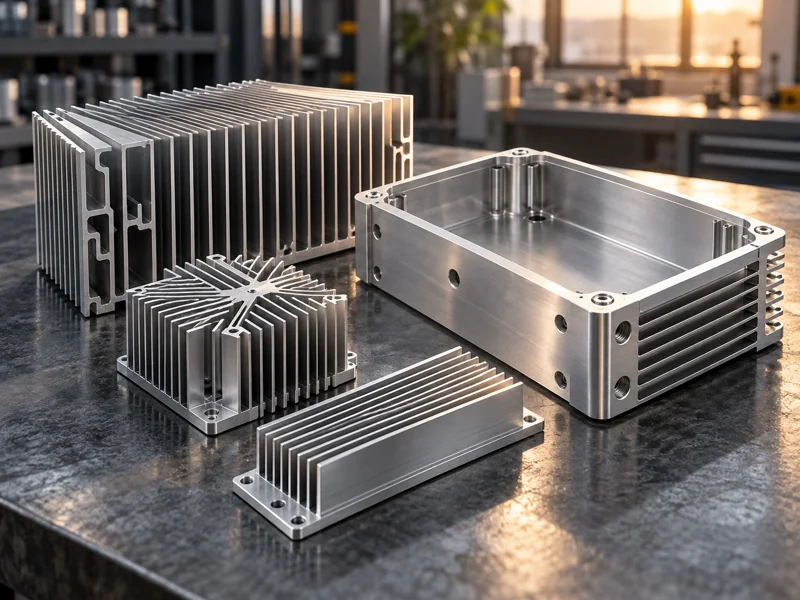
Start with the delivered assembly
A heat sink purchase begins with the cooling arrangement and device interface. More fins, a darker finish or a larger outline are insufficient to establish performance in an installed assembly. Give the thermal designer’s operating conditions to the supplier and define the mechanical deliverable before comparing offers. Record which thermal assumptions still need validation.
Choose the purchasing scope
Existing extruded section
Research this route when a catalog cross-section fits the assembly space. Request its drawing and thermal data with stated test conditions; current stock and commercial terms still need confirmation.
Custom extruded and machined part
Discuss tooling when the controlled base, fins or interface requires a new section. Ask for feasibility review and identify every machined contact surface and mounting feature.
Another heat sink construction
If the proposed extrusion cannot meet design requirements, ask the design owner to compare another construction. Keep the changed process, geometry and validation requirements in the proposal.
Define order-specific requirements
- Thermal operating conditions
- Provide dissipated power, ambient conditions, allowed device or interface temperature, duty cycle and the designer’s validation method. Keep supplier assumptions visible.
- Airflow and installation
- Describe natural or forced airflow, orientation, enclosure space and fin clearances. Ask whether quoted thermal data represents your installed arrangement.
- Geometry and contact area
- Provide the envelope, base geometry, fin arrangement and device contact footprint. Mark mounting datums and required surface condition on the drawing.
- Machining and interface materials
- List drilling, tapping, milling, deburring and thermal-interface-material scope. Identify the assembly method and who supplies each interface component.
- Finish and masking
- Specify finish and controlled treatment on contact, grounding, threaded and mating areas. Review finish proposals with the thermal and product designer.
- Validation and repeat orders
- Agree prototype identity, dimensional checks, test arrangement and approval owner. Keep a validated finished assembly distinct from an untested extrusion sample.
Avoid these quote-comparison gaps
Thermal data without test conditions
Ask for the conditions behind a stated result. Open-test data alone does not establish performance inside your enclosure.
Appearance accepted as thermal proof
Record geometry, interfaces and operating conditions. Finish color and photographs do not replace thermal validation.
Contact machining missing from price
List contact-face work, holes, threads, interface materials and inspection. A raw cut extrusion and a mounting-ready part have different scope.
Prepare your application checklist
Use these prompts to prepare a written requirement. Download a working note before leaving. Inputs remain in this page; the tool does not select dimensions, approve the design or send an inquiry.
Research suppliers and request missing evidence
The profile supplier guide connects seven company-source records. These describe general extrusion scope; they do not establish readiness for this application. Ask for the exact section, operations, inspection proposal and responsible production site.
Buyer questions
Does more fin count always mean better cooling?
Do not select by fin count alone. Ask the thermal designer to assess fins together with airflow, installation space and operating conditions.
Can I use catalog thermal data for my enclosure?
Compare stated test conditions with the installed arrangement. Record airflow, orientation, ambient and interface assumptions, then agree validation.
Does the quote include a finished contact face?
Only if the operation and acceptance requirement are specified. Provide the contact footprint, datums and product designer’s surface requirements.
When should I discuss a non-extruded option?
Raise the question when extrusion feasibility or performance requirements remain unresolved. Compare the alternative’s geometry, process and validation before approval.
Technical background and review boundary
Eaton describes a base and fins transferring heat to surrounding air with natural or fan-driven convection, and distinguishes extruded, stamped and advanced constructions. This background does not establish performance for the buyer’s assembly. Eaton heat sink technology overview.
Primary source reviewed 3 October 2026. Other prompts are AlumHome editorial procurement guidance. The responsible designer sets performance and acceptance requirements; a purchase checklist is not engineering approval.