Industrial Aluminum Framing Profiles
Choose the section, connections and delivered assembly scope for workstations, machine frames and equipment supports.
See the application
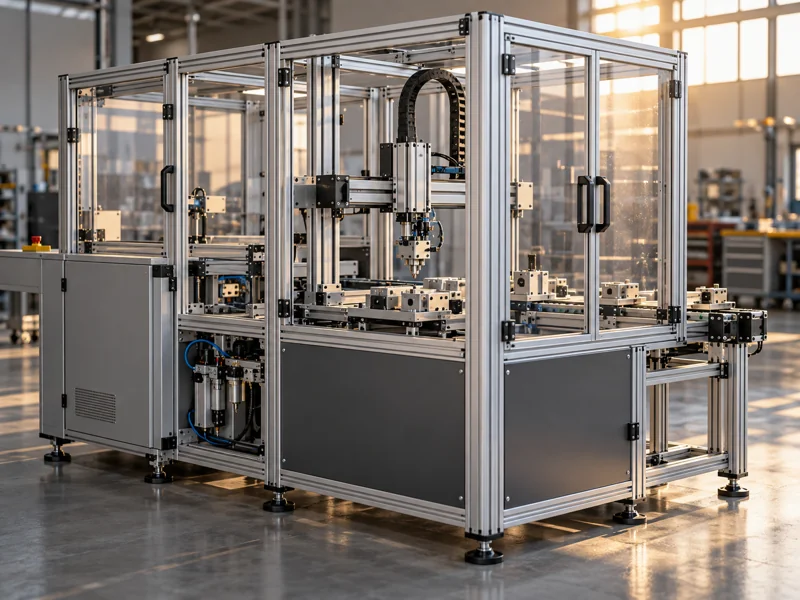
Start with the delivered assembly
A framing inquiry should describe the assembly it must support. A nominal profile size or a photograph does not establish stiffness, joint behavior or compatibility of a replacement member. Begin with controlled section and assembly drawings. Record member lengths, loads and interfaces, then compare suppliers at the same delivered stage.
Choose the purchasing scope
Cut profile lengths
Use this route when your team owns assembly design and hardware selection. Request the exact section drawing, cut list, deburring and length inspection. Connectors and panels need separate lines in the offer.
Machined members and hardware
Use a parts package when mounting holes, access bores, threaded ends or hardware must arrive ready for assembly. Match each operation and connector to the controlled bill of materials.
Assembled frame or workstation
Specify connections, panels, feet and packing for installation. Record who checks final geometry, who coordinates component interfaces and who supplies assembly instructions.
Define order-specific requirements
- Assembly and span
- Provide member lengths, support locations, load positions and the design owner’s deflection or alignment requirement. Identify vibration and moving loads separately; do not replace these inputs with a profile-size label.
- Cross-section and slot interface
- Provide the section drawing, slot geometry and mating hardware references. Two profiles with the same outside dimensions can have different walls, slots and interfaces.
- Connection method
- List brackets, internal fasteners, end preparation and joint parts. Require a bill of materials rather than assuming all hardware is included in a per-metre quotation.
- Cutting and machining
- Mark lengths, holes, threads, datum faces and orientation. Agree which dimensions are inspected after finishing and which features must remain masked.
- Material and finish
- Record alloy, temper and appearance requirements. Identify visible surfaces, cleaning exposure and treatment on mating or electrical-contact areas.
- Acceptance and packing
- Agree cut-list checks, assembly fit checks and first-article identity. Specify packing that protects long members and finished faces, and identify any assembly required after delivery.
Avoid these quote-comparison gaps
Comparing profile mass alone
Compare the exact section and assembly arrangement. Ask the designer to assess stiffness and connections; a price per kilogram does not describe the supplied frame.
Treating slots as interchangeable
Obtain section and hardware drawings before accepting a substitute. Similar-looking slots are insufficient evidence of fastener or panel fit.
Ignoring delivered-stage differences
Separate raw lengths, machined parts, hardware kits and complete assemblies. Compare total scope, including inspection and packing.
Prepare your application checklist
Use these prompts to prepare a written requirement. Download a working note before leaving. Inputs remain in this page; the tool does not select dimensions, approve the design or send an inquiry.
Research suppliers and request missing evidence
The profile supplier guide connects seven company-source records. These describe general extrusion scope; they do not establish readiness for this application. Ask for the exact section, operations, inspection proposal and responsible production site.
Buyer questions
Can I choose a frame by outside profile size?
Use size to describe a candidate, then check the section, length, loading and joint design. The responsible designer must set and verify assembly requirements.
Does a standard T-slot section include connectors?
Only when the written offer lists them. Request hardware identifiers and quantities, and state whether machining and assembly are included.
Can suppliers substitute a different slot series?
Ask for drawings and evidence of fit with mating parts. Obtain the design owner’s acceptance before authorizing a change.
What should the first sample demonstrate?
Tie it to the drawing revision. Check critical dimensions, machined features, finish and agreed interfaces, and record unresolved fields before production release.
Technical background and review boundary
80/20’s manufacturer tool uses the selected profile, length and load, and distinguishes support configurations. This illustrates why a nominal section size alone is insufficient to evaluate a frame. 80/20 deflection calculator documentation.
Primary source reviewed 3 October 2026. Other prompts are AlumHome editorial procurement guidance. The responsible designer sets performance and acceptance requirements; a purchase checklist is not engineering approval.